 Dansk
Dansk


Hall, Abigail R.
(forfatter)
Political Economy of Terrorism, Counterterrorism, and the War on Terror e-bog
165,78 DKK
This Element explores the topics of terrorism, counterterrorism, and the US government's war on terror following the September 11, 2001 terror attacks. It draw on insights from Austrian and public choice economics. First, the foundations of the economics of terrorism are discussed emphasizing that the behaviors of terrorists and counter-terrorists are purposeful and goal-oriented. Then, the econo…
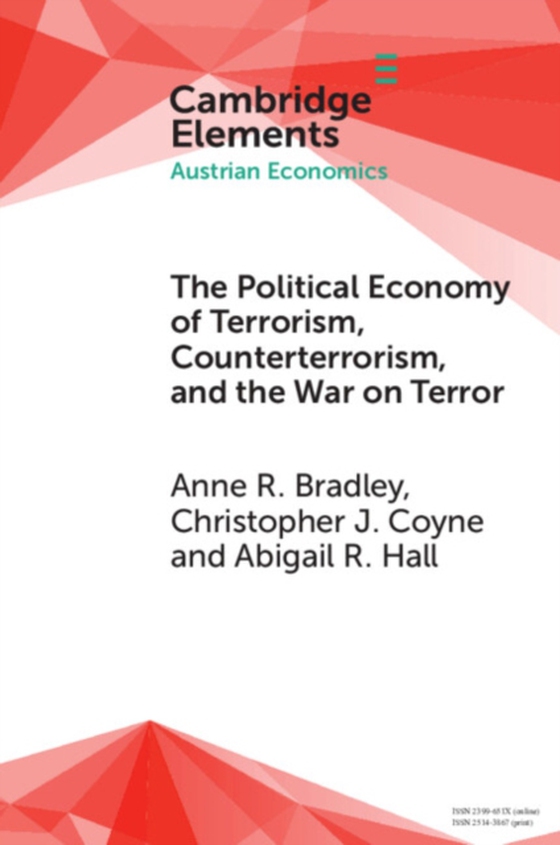
This Element explores the topics of terrorism, counterterrorism, and the US government's war on terror following the September 11, 2001 terror attacks. It draw on insights from Austrian and public choice economics. First, the foundations of the economics of terrorism are discussed emphasizing that the behaviors of terrorists and counter-terrorists are purposeful and goal-oriented. Then, the economics of counterterrorism policies and the importance of institutional change is considered. Next, the three dilemmas facing liberal societies as it relates to counterterrorism efforts is focused on. The Element then provides an assessment of the US government's war on terror. It discusses the origins of the war, discuss whether it can be judged a success or failure, and consider some of the main effects both abroad and within the United States. The final chapter concludes with a discussion of several areas for future research.
E-bog
165,78 DKK
Forlag
Cambridge University Press
Udgivet
31.08.2023
Genrer
1DFA
Sprog
English
Format
epub
Beskyttelse
LCP
ISBN
9781108587532
This Element explores the topics of terrorism, counterterrorism, and the US government's war on terror following the September 11, 2001 terror attacks. It draw on insights from Austrian and public choice economics. First, the foundations of the economics of terrorism are discussed emphasizing that the behaviors of terrorists and counter-terrorists are purposeful and goal-oriented. Then, the economics of counterterrorism policies and the importance of institutional change is considered. Next, the three dilemmas facing liberal societies as it relates to counterterrorism efforts is focused on. The Element then provides an assessment of the US government's war on terror. It discusses the origins of the war, discuss whether it can be judged a success or failure, and consider some of the main effects both abroad and within the United States. The final chapter concludes with a discussion of several areas for future research.