 Dansk
Dansk


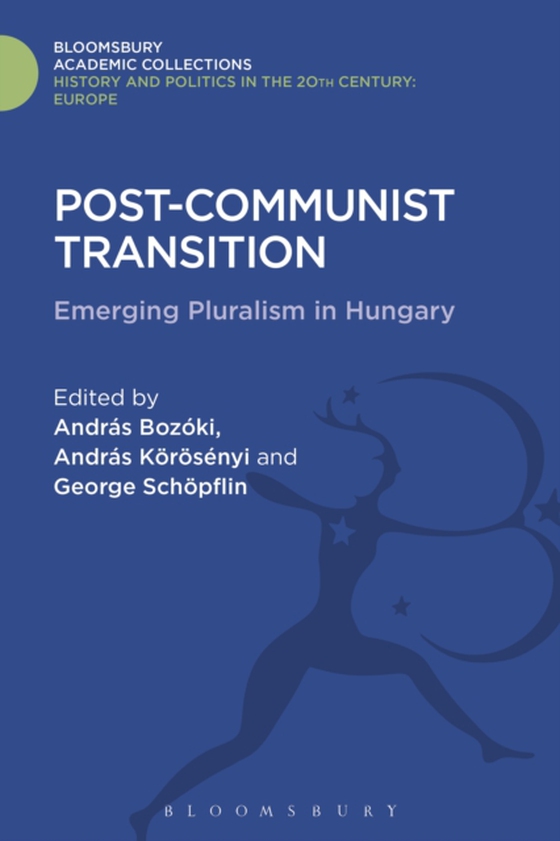
Post-Communist Transition e-bog
1185,51 DKK
(ekskl. moms 948,41 DKK)
The transition from communist dictatorship to multi-party democracy has proved a long and painful process for the countries of Eastern Europe, and has met with varying degrees of success. In Hungary, the radical opposition was uniquely successful in fighting off attempts by the old-guard communist elite to hijack reform programmes, by forcing free elections and creating a multi-party system. This…
The transition from communist dictatorship to multi-party democracy has proved a long and painful process for the countries of Eastern Europe, and has met with varying degrees of success. In Hungary, the radical opposition was uniquely successful in fighting off attempts by the old-guard communist elite to hijack reform programmes, by forcing free elections and creating a multi-party system. This volume focuses on the Hungarian experience, analysing in detail the process of transition from dictatorship to pluralist democracy. Some of Hungary's leading political scientists examine issues such as the legitimation crisis of communist rule, resulting struggles within the ruling elite and the forces behind transition. Constitutional reform, party formation and voting behaviour at the first free elections are also taken into account. The concluding section places the Hungarian experience in comparative perspective, within the context of other Central and Western European states.
E-bog
1185,51 DKK
Forlag
Bloomsbury Academic
Udgivet
06.10.2016
Længde
224 sider
Genrer
1DVH
Sprog
English
Format
pdf
Beskyttelse
LCP
ISBN
9781474287814
The transition from communist dictatorship to multi-party democracy has proved a long and painful process for the countries of Eastern Europe, and has met with varying degrees of success. In Hungary, the radical opposition was uniquely successful in fighting off attempts by the old-guard communist elite to hijack reform programmes, by forcing free elections and creating a multi-party system. This volume focuses on the Hungarian experience, analysing in detail the process of transition from dictatorship to pluralist democracy. Some of Hungary's leading political scientists examine issues such as the legitimation crisis of communist rule, resulting struggles within the ruling elite and the forces behind transition. Constitutional reform, party formation and voting behaviour at the first free elections are also taken into account. The concluding section places the Hungarian experience in comparative perspective, within the context of other Central and Western European states.