 Dansk
Dansk


Egerton, Frank N.
(forfatter)
Hewett Cottrell Watson e-bog
158,16 DKK
First published in 2003. Hewett Cottrell Watson was a pioneer in a new science not yet defined in Victorian times - ecology - and was practically the first naturalist to conduct research on plant evolution, beginning in 1834. The correspondence between Watson and Darwin, analysed for the first time in this book, reveals the extent to which Darwin profited from Watson's data. Darwin's subsequent f…
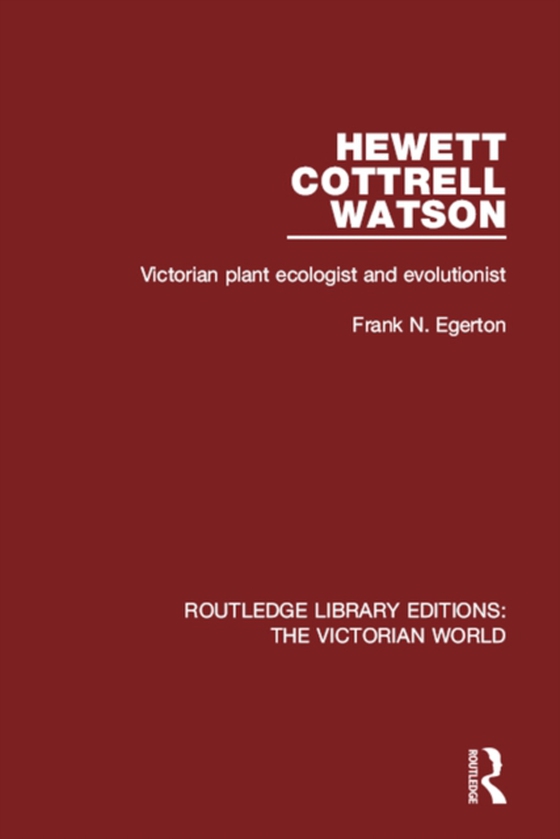
First published in 2003. Hewett Cottrell Watson was a pioneer in a new science not yet defined in Victorian times - ecology - and was practically the first naturalist to conduct research on plant evolution, beginning in 1834. The correspondence between Watson and Darwin, analysed for the first time in this book, reveals the extent to which Darwin profited from Watson's data. Darwin's subsequent fame, however, is one of the reasons why Watson became almost forgotten. This biography traces both the influences and characteristics that shaped Watson's outlook and personality, and indeed his science, and the institutional contexts within which he worked. At the same time, it makes evident the extent of his real contributions to the science of the plant ecology and evolution.
E-bog
158,16 DKK
Forlag
Routledge
Udgivet
01.07.2016
Længde
284 sider
Genrer
3JH
Sprog
English
Format
epub
Beskyttelse
LCP
ISBN
9781317243809
First published in 2003. Hewett Cottrell Watson was a pioneer in a new science not yet defined in Victorian times - ecology - and was practically the first naturalist to conduct research on plant evolution, beginning in 1834. The correspondence between Watson and Darwin, analysed for the first time in this book, reveals the extent to which Darwin profited from Watson's data. Darwin's subsequent fame, however, is one of the reasons why Watson became almost forgotten. This biography traces both the influences and characteristics that shaped Watson's outlook and personality, and indeed his science, and the institutional contexts within which he worked. At the same time, it makes evident the extent of his real contributions to the science of the plant ecology and evolution.