 Dansk
Dansk


Wilson, Mark
(forfatter)
Imitation of Rigor e-bog
583,01 DKK
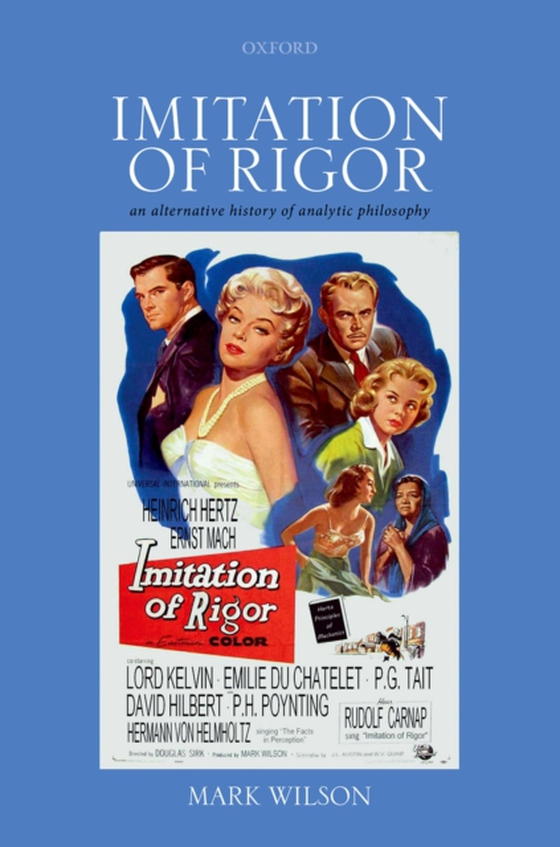
J.L. Austin has written of "e;the blinding veil of ease and obviousness that hides the mechanisms of the natural successful act"e;. By revisiting a classic "e;small metaphysics"e; puzzle drawn from physics that launched a thousand ships of grander philosophizing, Imitation of Rigor employs recent insights into the architectures of effective reasoning as a means of explicating how …
J.L. Austin has written of "e;the blinding veil of ease and obviousness that hides the mechanisms of the natural successful act"e;. By revisiting a classic "e;small metaphysics"e; puzzle drawn from physics that launched a thousand ships of grander philosophizing, Imitation of Rigor employs recent insights into the architectures of effective reasoning as a means of explicating how Austin's covert "e;mechanisms"e; operate in concrete terms. By these means, the bookattempts to reconnect analytic philosophy with the evolving practicalities within science from which many of its grander concerns originally sprang. In doing so, it provides an "e;alternative history"e; of how the subject might have developed had the diagnostic insights of its philosopher/scientist forebears (e.g. Heinrich Hertz and Ernst Mach) not been cast aside in the vain pursuit of inappropriate standards of "e;ersatz rigor"e;.
E-bog
583,01 DKK
Forlag
OUP Oxford
Udgivet
16.12.2021
Længde
240 sider
Genrer
Philosophy of language
Sprog
English
Format
pdf
Beskyttelse
LCP
ISBN
9780192650368
J.L. Austin has written of "e;the blinding veil of ease and obviousness that hides the mechanisms of the natural successful act"e;. By revisiting a classic "e;small metaphysics"e; puzzle drawn from physics that launched a thousand ships of grander philosophizing, Imitation of Rigor employs recent insights into the architectures of effective reasoning as a means of explicating how Austin's covert "e;mechanisms"e; operate in concrete terms. By these means, the bookattempts to reconnect analytic philosophy with the evolving practicalities within science from which many of its grander concerns originally sprang. In doing so, it provides an "e;alternative history"e; of how the subject might have developed had the diagnostic insights of its philosopher/scientist forebears (e.g. Heinrich Hertz and Ernst Mach) not been cast aside in the vain pursuit of inappropriate standards of "e;ersatz rigor"e;.