 Dansk
Dansk


New Science e-bog
240,51 DKK
(ekskl. moms 192,41 DKK)
A fresh translation of The New Science, with detailed footnotes that will help both the scholar and the new reader navigate Vico’s masterpieceThe New Science is the major work of Italian philosopher Giambattista Vico. First published in 1725 and revised in 1730 and 1744, it calls for a reinterpretation of human civilization by tracing the stages of historical development shared by all socie…
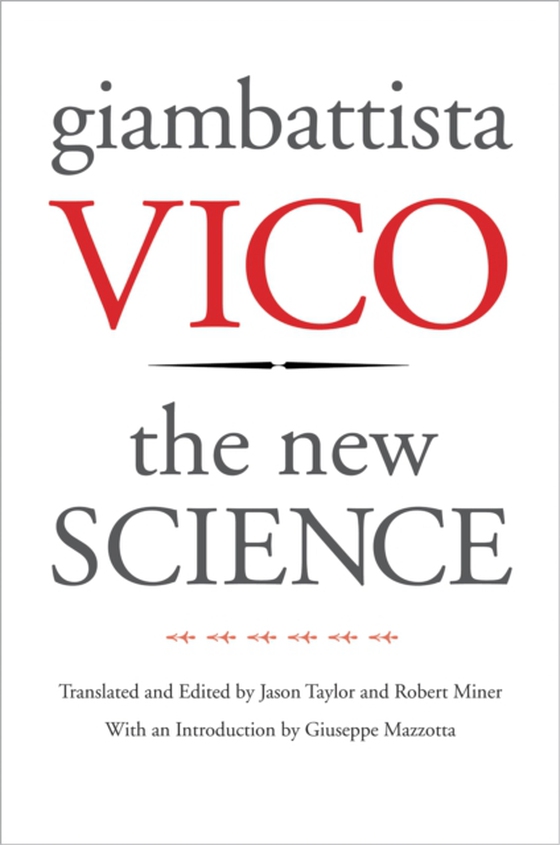
A fresh translation of The New Science, with detailed footnotes that will help both the scholar and the new reader navigate Vico’s masterpieceThe New Science is the major work of Italian philosopher Giambattista Vico. First published in 1725 and revised in 1730 and 1744, it calls for a reinterpretation of human civilization by tracing the stages of historical development shared by all societies. Almost unknown during his lifetime, the work had a profound influence on later thinkers, from Montesquieu and Marx to Joyce and Gadamer. This edition offers a fresh translation and detailed annotations which enable the reader to track Vico’s multiple allusions to other texts. The introduction situates the work firmly within a contemporary context and newly establishes Vico as a thinker of modernity.
E-bog
240,51 DKK
Forlag
Yale University Press
Udgivet
07.01.2020
Længde
512 sider
Genrer
HBAH
Sprog
English
Format
pdf
Beskyttelse
LCP
ISBN
9780300249606
A fresh translation of The New Science, with detailed footnotes that will help both the scholar and the new reader navigate Vico’s masterpieceThe New Science is the major work of Italian philosopher Giambattista Vico. First published in 1725 and revised in 1730 and 1744, it calls for a reinterpretation of human civilization by tracing the stages of historical development shared by all societies. Almost unknown during his lifetime, the work had a profound influence on later thinkers, from Montesquieu and Marx to Joyce and Gadamer. This edition offers a fresh translation and detailed annotations which enable the reader to track Vico’s multiple allusions to other texts. The introduction situates the work firmly within a contemporary context and newly establishes Vico as a thinker of modernity.