 Dansk
Dansk


Hancock, Peter A.
(redaktør)
Human Performance, Situation Awareness, and Automation e-bog
692,63 DKK
In 2000, the Conference on Automation joined forces with a partner group on situation awareness (SA). The rising complexity of systems demands that one can be aware of a large range of environmental and task-based stimulation in order to match what is done with what has to be done. Thus, SA and automation-based interaction fall naturally together and this conference is the second embodiment of th…
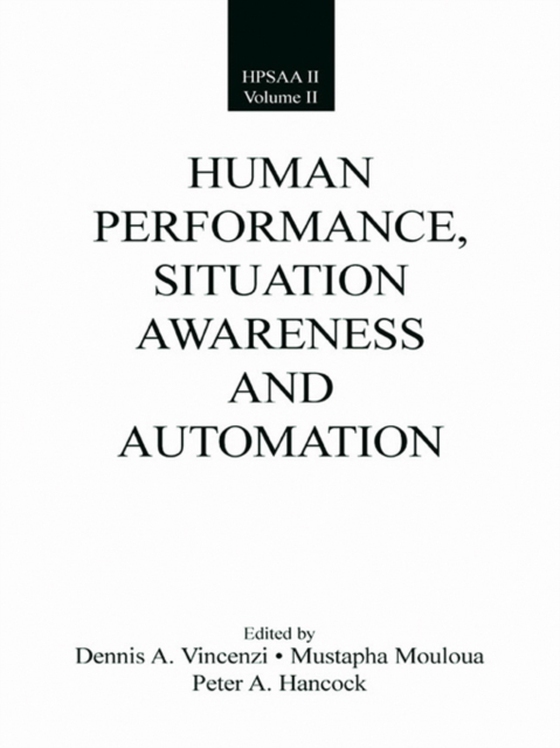
In 2000, the Conference on Automation joined forces with a partner group on situation awareness (SA). The rising complexity of systems demands that one can be aware of a large range of environmental and task-based stimulation in order to match what is done with what has to be done. Thus, SA and automation-based interaction fall naturally together and this conference is the second embodiment of this union. Moving into the 21st century, further diversification of the applications of automation will continue--for example, the revolution in genetic technology. Given the broad nature of this form of human-machine interaction, it is vital to apply past lessons to map a future for the symbiotic relationship between humans and the artifacts they create. It is as part of this ongoing endeavor that the present volume is offered.
E-bog
692,63 DKK
Forlag
Psychology Press
Udgivet
06.01.2005
Længde
336 sider
Genrer
Psychology
Sprog
English
Format
pdf
Beskyttelse
LCP
ISBN
9781135604332
In 2000, the Conference on Automation joined forces with a partner group on situation awareness (SA). The rising complexity of systems demands that one can be aware of a large range of environmental and task-based stimulation in order to match what is done with what has to be done. Thus, SA and automation-based interaction fall naturally together and this conference is the second embodiment of this union. Moving into the 21st century, further diversification of the applications of automation will continue--for example, the revolution in genetic technology. Given the broad nature of this form of human-machine interaction, it is vital to apply past lessons to map a future for the symbiotic relationship between humans and the artifacts they create. It is as part of this ongoing endeavor that the present volume is offered.