 Dansk
Dansk


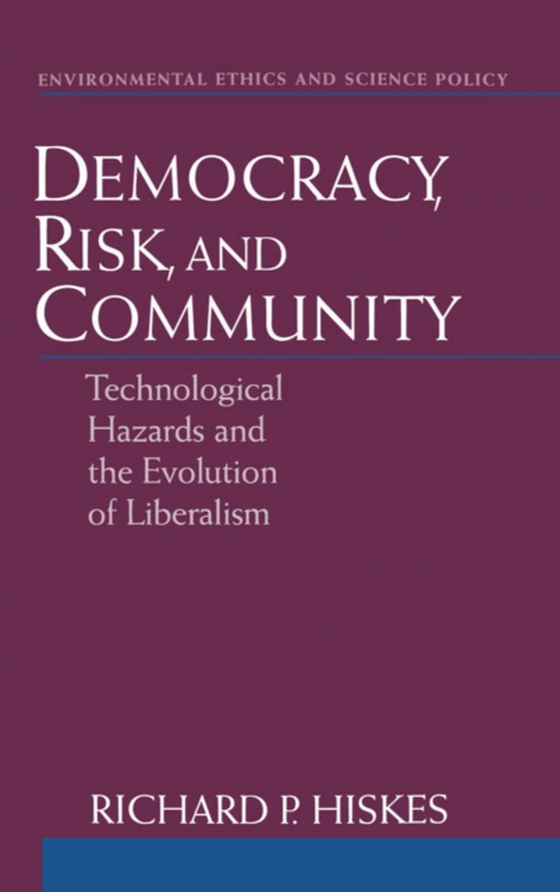
Democracy, Risk, and Community e-bog
1550,91 DKK
(ekskl. moms 1240,73 DKK)
This book presents a novel and compelling thesis about technological risk, liberalism, and policy making in liberal societies. Opposed to most theories of risk that focus on individual decision makers and models or rational choice, this book argues that risks must be seen as intrinsically both emergent and political phenomena. As such, risks resist reduction to individual actors, events, or decis…
This book presents a novel and compelling thesis about technological risk, liberalism, and policy making in liberal societies. Opposed to most theories of risk that focus on individual decision makers and models or rational choice, this book argues that risks must be seen as intrinsically both emergent and political phenomena. As such, risks resist reduction to individual actors, events, or decisions. To fully understand and make policy for risk, then, it is necessary to recognize that risks call attention to the connections between individuals and events, to the power being exercised in the determination and distribution of risks, and to how the failure to see risks as political, emergent phenomena results in policy failure, as in instances of "e;Not in My Backyard"e; (NIMBY) controversies. Liberal societies have particular difficulty in coping with risk, due to the excessively individualistic political theory and epistemology that undergirds liberalism. Thus, seeing risks as emergent has dramatic impact on the fundamental political concepts that make up liberal political theory and operate within liberal societies. The book treats especially the concepts of consent, community, authority, rights, responsibility, identity, and political participation. The meaning of each of these ideas has been altered by modern technological risks, and coping with risk will require that liberal societies redefine what these most basic concepts of political principles are to mean in political practice and policy making.
E-bog
1550,91 DKK
Forlag
Oxford University Press
Udgivet
08.10.1998
Genrer
Political science and theory
Sprog
English
Format
pdf
Beskyttelse
LCP
ISBN
9780195353129
This book presents a novel and compelling thesis about technological risk, liberalism, and policy making in liberal societies. Opposed to most theories of risk that focus on individual decision makers and models or rational choice, this book argues that risks must be seen as intrinsically both emergent and political phenomena. As such, risks resist reduction to individual actors, events, or decisions. To fully understand and make policy for risk, then, it is necessary to recognize that risks call attention to the connections between individuals and events, to the power being exercised in the determination and distribution of risks, and to how the failure to see risks as political, emergent phenomena results in policy failure, as in instances of "e;Not in My Backyard"e; (NIMBY) controversies. Liberal societies have particular difficulty in coping with risk, due to the excessively individualistic political theory and epistemology that undergirds liberalism. Thus, seeing risks as emergent has dramatic impact on the fundamental political concepts that make up liberal political theory and operate within liberal societies. The book treats especially the concepts of consent, community, authority, rights, responsibility, identity, and political participation. The meaning of each of these ideas has been altered by modern technological risks, and coping with risk will require that liberal societies redefine what these most basic concepts of political principles are to mean in political practice and policy making.