 Dansk
Dansk


Corrales, Javier
(forfatter)
Fixing Democracy e-bog
188,61 DKK
The study of institutions, a core concept in comparative politics, has produced many rich and influential theories on the economic and political effects of institutions, yet it has been less successful at theorizing their origins. In Fixing Democracy, Javier Corrales develops a theory of institutional origins that concentrates on constitutions and levels of power within them. He reviews numerous …
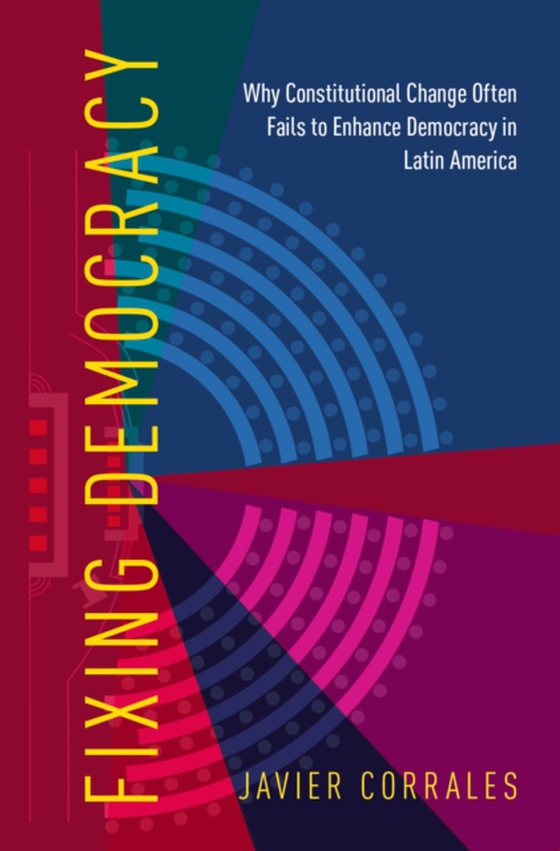
The study of institutions, a core concept in comparative politics, has produced many rich and influential theories on the economic and political effects of institutions, yet it has been less successful at theorizing their origins. In Fixing Democracy, Javier Corrales develops a theory of institutional origins that concentrates on constitutions and levels of power within them. He reviews numerous Latin American constituent assemblies and constitutional amendments to explore why some democracies expand rather than restrict presidential powers and why this heightened presidentialism discourages democracy. His signal theoretical contribution is his elaboration on power asymmetries. Corrales determines that conditions of reduced power asymmetry make constituent assemblies more likely to curtail presidential powers, while weaker opposition and heightened power asymmetry is an indicator that presidential powers will expand. The bargain-based theory that he uses focuses on power distribution and provides a more accurate variable in predicting actual constitutional outcomes than other approaches based on functionalism or ideology. While the empirical focus is Latin America, Fixing Democracy contributes a broadly applicable theory to the scholarship both institutions and democracy.
E-bog
188,61 DKK
Forlag
Oxford University Press
Udgivet
29.05.2018
Længde
288 sider
Genrer
Comparative politics
Sprog
English
Format
epub
Beskyttelse
LCP
ISBN
9780190868925
The study of institutions, a core concept in comparative politics, has produced many rich and influential theories on the economic and political effects of institutions, yet it has been less successful at theorizing their origins. In Fixing Democracy, Javier Corrales develops a theory of institutional origins that concentrates on constitutions and levels of power within them. He reviews numerous Latin American constituent assemblies and constitutional amendments to explore why some democracies expand rather than restrict presidential powers and why this heightened presidentialism discourages democracy. His signal theoretical contribution is his elaboration on power asymmetries. Corrales determines that conditions of reduced power asymmetry make constituent assemblies more likely to curtail presidential powers, while weaker opposition and heightened power asymmetry is an indicator that presidential powers will expand. The bargain-based theory that he uses focuses on power distribution and provides a more accurate variable in predicting actual constitutional outcomes than other approaches based on functionalism or ideology. While the empirical focus is Latin America, Fixing Democracy contributes a broadly applicable theory to the scholarship both institutions and democracy.