 Dansk
Dansk


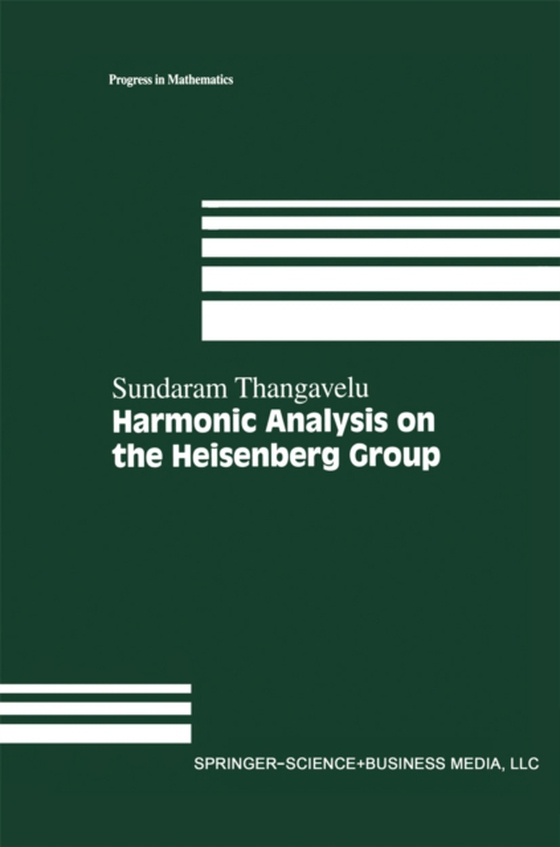
Thangavelu, Sundaram
(redaktør)
Harmonic Analysis on the Heisenberg Group e-bog
948,41 DKK
The Heisenberg group plays an important role in several branches of mathematics, such as representation theory, partial differential equations, number theory, several complex variables and quantum mechanics. This monograph deals with various aspects of harmonic analysis on the Heisenberg group, which is the most commutative among the non-commutative Lie groups, and hence gives the greatest opport…
The Heisenberg group plays an important role in several branches of mathematics, such as representation theory, partial differential equations, number theory, several complex variables and quantum mechanics. This monograph deals with various aspects of harmonic analysis on the Heisenberg group, which is the most commutative among the non-commutative Lie groups, and hence gives the greatest opportunity for generalizing the remarkable results of Euclidean harmonic analysis. The aim of this text is to demonstrate how the standard results of abelian harmonic analysis take shape in the non-abelian setup of the Heisenberg group. Thangavelu's exposition is clear and well developed, and leads to several problems worthy of further consideration. Any reader who is interested in pursuing research on the Heisenberg group will find this unique and self-contained text invaluable.
E-bog
948,41 DKK
Forlag
Birkhauser
Udgivet
06.12.2012
Genrer
PBG
Sprog
English
Format
pdf
Beskyttelse
LCP
ISBN
9781461217725
The Heisenberg group plays an important role in several branches of mathematics, such as representation theory, partial differential equations, number theory, several complex variables and quantum mechanics. This monograph deals with various aspects of harmonic analysis on the Heisenberg group, which is the most commutative among the non-commutative Lie groups, and hence gives the greatest opportunity for generalizing the remarkable results of Euclidean harmonic analysis. The aim of this text is to demonstrate how the standard results of abelian harmonic analysis take shape in the non-abelian setup of the Heisenberg group. Thangavelu's exposition is clear and well developed, and leads to several problems worthy of further consideration. Any reader who is interested in pursuing research on the Heisenberg group will find this unique and self-contained text invaluable.