 Dansk
Dansk


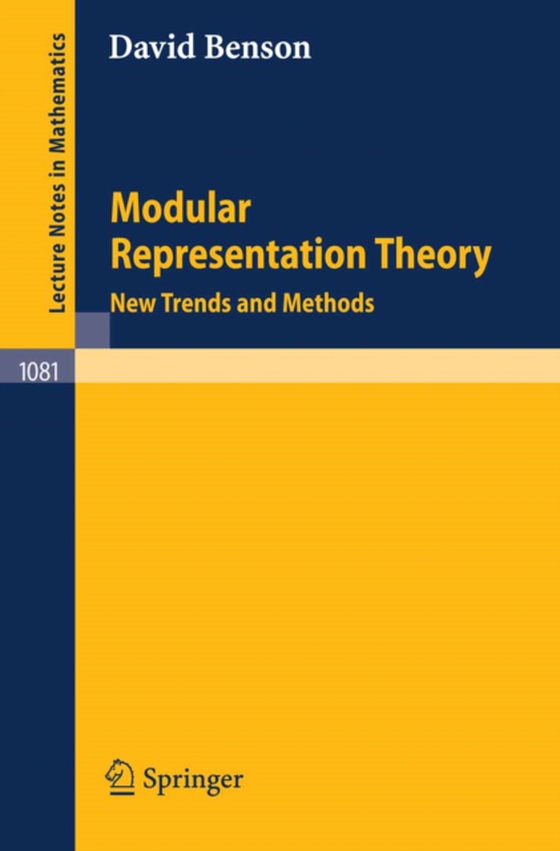
Benson, D.
(forfatter)
Modular Representation Theory e-bog
436,85 DKK
The aim of this 1983 Yale graduate course was to make some recent results in modular representation theory accessible to an audience ranging from second-year graduate students to established mathematicians. After a short review of background material, three closely connected topics in modular representation theory of finite groups are treated: representations rings, almost split sequences and the…
The aim of this 1983 Yale graduate course was to make some recent results in modular representation theory accessible to an audience ranging from second-year graduate students to established mathematicians. After a short review of background material, three closely connected topics in modular representation theory of finite groups are treated: representations rings, almost split sequences and the Auslander-Reiten quiver, complexity and cohomology varieties. The last of these has become a major theme in representation theory into the 21st century.Some of this material was incorporated into the author's 1991 two-volume Representations and Cohomology, but nevertheless Modular Representation Theory remains a useful introduction.
E-bog
436,85 DKK
Forlag
Springer
Udgivet
22.07.2008
Genrer
PBG
Sprog
English
Format
pdf
Beskyttelse
LCP
ISBN
9783540389408
The aim of this 1983 Yale graduate course was to make some recent results in modular representation theory accessible to an audience ranging from second-year graduate students to established mathematicians. After a short review of background material, three closely connected topics in modular representation theory of finite groups are treated: representations rings, almost split sequences and the Auslander-Reiten quiver, complexity and cohomology varieties. The last of these has become a major theme in representation theory into the 21st century.Some of this material was incorporated into the author's 1991 two-volume Representations and Cohomology, but nevertheless Modular Representation Theory remains a useful introduction.