 Dansk
Dansk


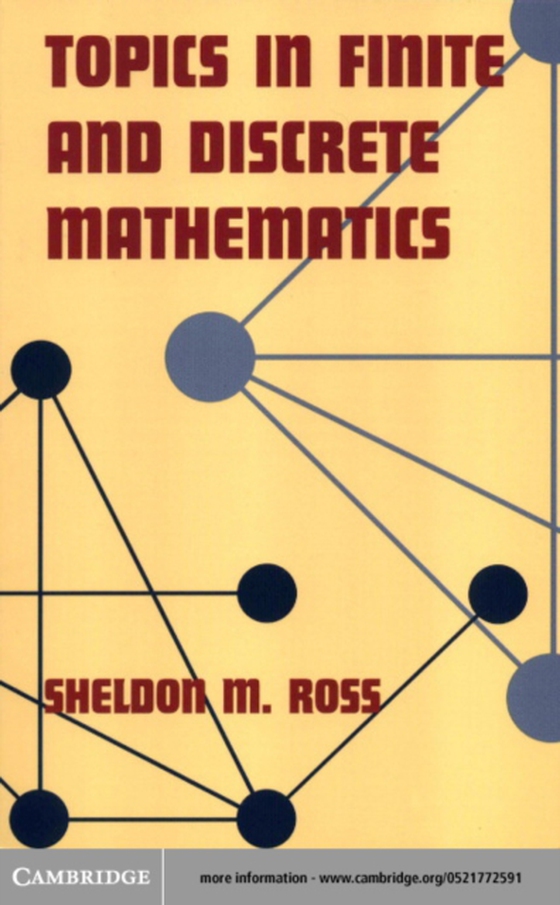
Ross, Sheldon M.
(forfatter)
Topics in Finite and Discrete Mathematics e-bog
948,41 DKK
Written for a broad audience of students in mathematics, computer science, operations research, statistics, and engineering, this textbook presents a short, lively survey of several fascinating non-calculus topics in modern applied mathematics. Coverage includes probability, mathematical finance, graphs, linear programming, statistics, computer science algorithms, and groups. A key feature is the…
Written for a broad audience of students in mathematics, computer science, operations research, statistics, and engineering, this textbook presents a short, lively survey of several fascinating non-calculus topics in modern applied mathematics. Coverage includes probability, mathematical finance, graphs, linear programming, statistics, computer science algorithms, and groups. A key feature is the abundance of interesting examples not normally found in standard finite mathematics courses, such as options pricing and arbitrage, tournaments, and counting formulas. The author assumes a level of mathematical sophistication at the beginning calculus level, that is, students should have had at least a course in pre-calculus, and the added sophistication attained from studying calculus would be useful.
E-bog
948,41 DKK
Forlag
Cambridge University Press
Udgivet
28.01.2005
Genrer
Probability and statistics
Sprog
English
Format
pdf
Beskyttelse
LCP
ISBN
9780511034541
Written for a broad audience of students in mathematics, computer science, operations research, statistics, and engineering, this textbook presents a short, lively survey of several fascinating non-calculus topics in modern applied mathematics. Coverage includes probability, mathematical finance, graphs, linear programming, statistics, computer science algorithms, and groups. A key feature is the abundance of interesting examples not normally found in standard finite mathematics courses, such as options pricing and arbitrage, tournaments, and counting formulas. The author assumes a level of mathematical sophistication at the beginning calculus level, that is, students should have had at least a course in pre-calculus, and the added sophistication attained from studying calculus would be useful.