 Dansk
Dansk


Thouless, D. J.
(forfatter)
Quantum Mechanics of Many-Body Systems e-bog
223,05 DKK
The Quantum Mechanics of Many-Body Systems provides an introduction to that field of theoretical physics known as "e;"e;many-body theory."e;"e; It is concerned with problems that are common to nuclear physics, atomic physics, the electron theory of metals, and to the theories of liquid helium three and four, and it describes the methods which have recently been developed to solve …
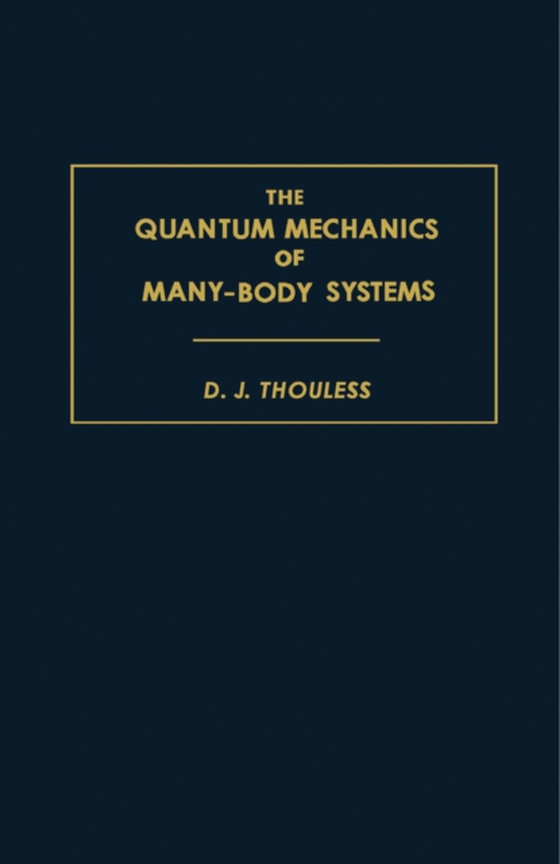
The Quantum Mechanics of Many-Body Systems provides an introduction to that field of theoretical physics known as "e;"e;many-body theory."e;"e; It is concerned with problems that are common to nuclear physics, atomic physics, the electron theory of metals, and to the theories of liquid helium three and four, and it describes the methods which have recently been developed to solve such problems. The aim has been to produce a unified account of the field, rather than to describe all the parallel methods that have been developed; as a result, a number of important papers are not mentioned. The main emphasis is on the theories of atomic nuclei, the electron gas, and liquid helium; there is no discussion of molecular theory or of solid helium. The reader is expected to be familiar with the principles of nonrelativistic quantum mechanics and of statistical mechanics, but a knowledge of field theory and a detailed knowledge of nuclear and solid state physics are not assumed.
E-bog
223,05 DKK
Forlag
Academic Press
Udgivet
22.10.2013
Længde
186 sider
Genrer
Physics
Sprog
English
Format
pdf
Beskyttelse
LCP
ISBN
9781483275963
The Quantum Mechanics of Many-Body Systems provides an introduction to that field of theoretical physics known as "e;"e;many-body theory."e;"e; It is concerned with problems that are common to nuclear physics, atomic physics, the electron theory of metals, and to the theories of liquid helium three and four, and it describes the methods which have recently been developed to solve such problems. The aim has been to produce a unified account of the field, rather than to describe all the parallel methods that have been developed; as a result, a number of important papers are not mentioned. The main emphasis is on the theories of atomic nuclei, the electron gas, and liquid helium; there is no discussion of molecular theory or of solid helium. The reader is expected to be familiar with the principles of nonrelativistic quantum mechanics and of statistical mechanics, but a knowledge of field theory and a detailed knowledge of nuclear and solid state physics are not assumed.