 Dansk
Dansk


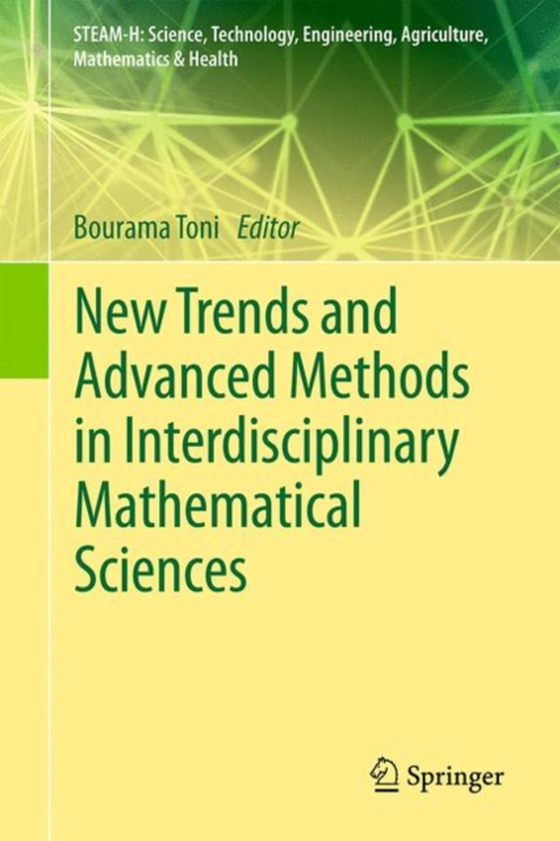
Toni, Bourama
(redaktør)
New Trends and Advanced Methods in Interdisciplinary Mathematical Sciences e-bog
1240,73 DKK
The latest of five multidisciplinary volumes, this book spans the STEAM-H (Science, Technology, Engineering, Agriculture, Mathematics, and Health) disciplines with the intent to generate meaningful interdisciplinary interaction and student interest. Emphasis is placed on important methods and applications within and beyond each field. Topics include geometric triple systems, image segmentation, p…
The latest of five multidisciplinary volumes, this book spans the STEAM-H (Science, Technology, Engineering, Agriculture, Mathematics, and Health) disciplines with the intent to generate meaningful interdisciplinary interaction and student interest. Emphasis is placed on important methods and applications within and beyond each field. Topics include geometric triple systems, image segmentation, pattern recognition in medicine, pricing barrier options, p-adic numbers distribution in geophysics data pattern, adelic physics, and evolutionary game theory. Contributions were by invitation only and peer-reviewed. Each chapter is reasonably self-contained and pedagogically presented for a multidisciplinary readership.
E-bog
1240,73 DKK
Forlag
Springer
Udgivet
05.07.2017
Genrer
Mathematical physics
Sprog
English
Format
epub
Beskyttelse
LCP
ISBN
9783319556123
The latest of five multidisciplinary volumes, this book spans the STEAM-H (Science, Technology, Engineering, Agriculture, Mathematics, and Health) disciplines with the intent to generate meaningful interdisciplinary interaction and student interest. Emphasis is placed on important methods and applications within and beyond each field. Topics include geometric triple systems, image segmentation, pattern recognition in medicine, pricing barrier options, p-adic numbers distribution in geophysics data pattern, adelic physics, and evolutionary game theory. Contributions were by invitation only and peer-reviewed. Each chapter is reasonably self-contained and pedagogically presented for a multidisciplinary readership.