 Dansk
Dansk


Masubuchi, Koichi
(forfatter)
Analysis of Welded Structures e-bog
619,55 DKK
Analysis of Welded Structures: Residual Stresses, Distortion, and their Consequences encompasses several topics related to design and fabrication of welded structures, particularly residual stresses and distortion, as well as their consequences. This book first introduces the subject by presenting the advantages and disadvantages of welded structures, as well as the historical overview of the to…
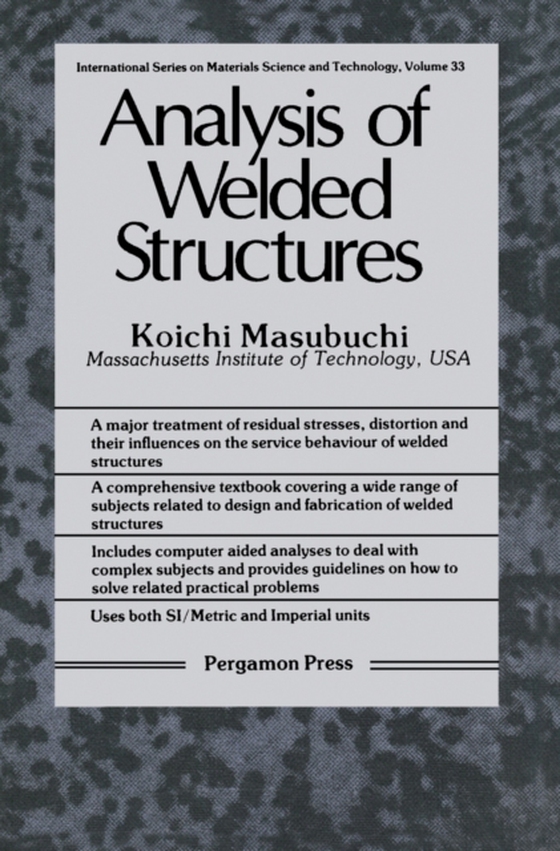
Analysis of Welded Structures: Residual Stresses, Distortion, and their Consequences encompasses several topics related to design and fabrication of welded structures, particularly residual stresses and distortion, as well as their consequences. This book first introduces the subject by presenting the advantages and disadvantages of welded structures, as well as the historical overview of the topic and predicted trends. Then, this text considers residual stresses, heat flow, distortion, fracture toughness, and brittle and fatigue fractures of weldments. This selection concludes by discussing the effects of distortion and residual stresses on buckling strength of welded structures and effects of weld defects on service behavior. This book also provides supplementary discussions on some related and selected subjects. This text will be invaluable to metallurgists, welders, and students of metallurgy and welding.
E-bog
619,55 DKK
Forlag
Pergamon
Udgivet
22.10.2013
Længde
654 sider
Genrer
Industrial chemistry and manufacturing technologies
Sprog
English
Format
pdf
Beskyttelse
LCP
ISBN
9781483188430
Analysis of Welded Structures: Residual Stresses, Distortion, and their Consequences encompasses several topics related to design and fabrication of welded structures, particularly residual stresses and distortion, as well as their consequences. This book first introduces the subject by presenting the advantages and disadvantages of welded structures, as well as the historical overview of the topic and predicted trends. Then, this text considers residual stresses, heat flow, distortion, fracture toughness, and brittle and fatigue fractures of weldments. This selection concludes by discussing the effects of distortion and residual stresses on buckling strength of welded structures and effects of weld defects on service behavior. This book also provides supplementary discussions on some related and selected subjects. This text will be invaluable to metallurgists, welders, and students of metallurgy and welding.