 Dansk
Dansk


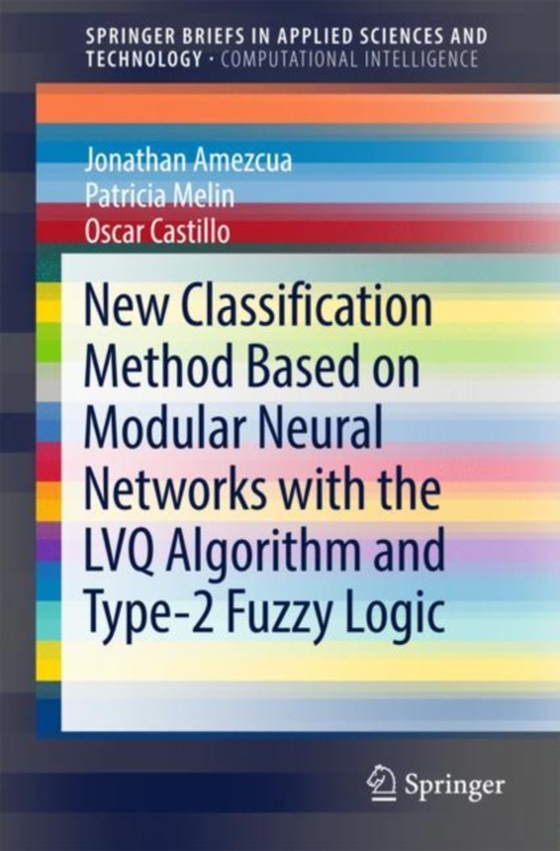
New Classification Method Based on Modular Neural Networks with the LVQ Algorithm and Type-2 Fuzzy Logic e-bog
546,06 DKK
(ekskl. moms 436,85 DKK)
In this book a new model for data classification was developed. This new model is based on the competitive neural network Learning Vector Quantization (LVQ) and type-2 fuzzy logic. This computational model consists of the hybridization of the aforementioned techniques, using a fuzzy logic system within the competitive layer of the LVQ network to determine the shortest distance between a centroid…
E-bog
546,06 DKK
Af samme forfatter

New Bio-inspired Optimization Algorithm Based on the Self-defense Mechanism of Plants in Nature
Castillo, Oscar436,85 DKK
New Bio-inspired Optimization Algorithm Based on the Self-defense Mechanism of Plants in Nature
Castillo, Oscar436,85 DKK
General Type-2 Fuzzy Logic in Dynamic Parameter Adaptation for the Harmony Search Algorithm
Castillo, Oscar436,85 DKK
General Type-2 Fuzzy Logic in Dynamic Parameter Adaptation for the Harmony Search Algorithm
Castillo, Oscar436,85 DKK

Ensembles of Type 2 Fuzzy Neural Models and Their Optimization with Bio-Inspired Algorithms for Time Series Prediction
Castillo, Oscar436,85 DKK

Andre brugere har også købt




Forlag
Springer
Udgivet
2018-02-05
Genrer
Artificial intelligence
Sprog
English
Format
pdf
Beskyttelse
LCP
ISBN
9783319737737
In this book a new model for data classification was developed. This new model is based on the competitive neural network Learning Vector Quantization (LVQ) and type-2 fuzzy logic. This computational model consists of the hybridization of the aforementioned techniques, using a fuzzy logic system within the competitive layer of the LVQ network to determine the shortest distance between a centroid and an input vector. This new model is based on a modular LVQ architecture to further improve its performance on complex classification problems. It also implements a data-similarity process for preprocessing the datasets, in order to build dynamic architectures, having the classes with the highest degree of similarity in different modules. Some architectures were developed in order to work mainly with two datasets, an arrhythmia dataset (using ECG signals) for classifying 15 different types of arrhythmias, and a satellite images segments dataset used for classifying six different types of soil. Both datasets show interesting features that makes them interesting for testing new classification methods.